Elfriede Jelinek: Confrontation and Controversy
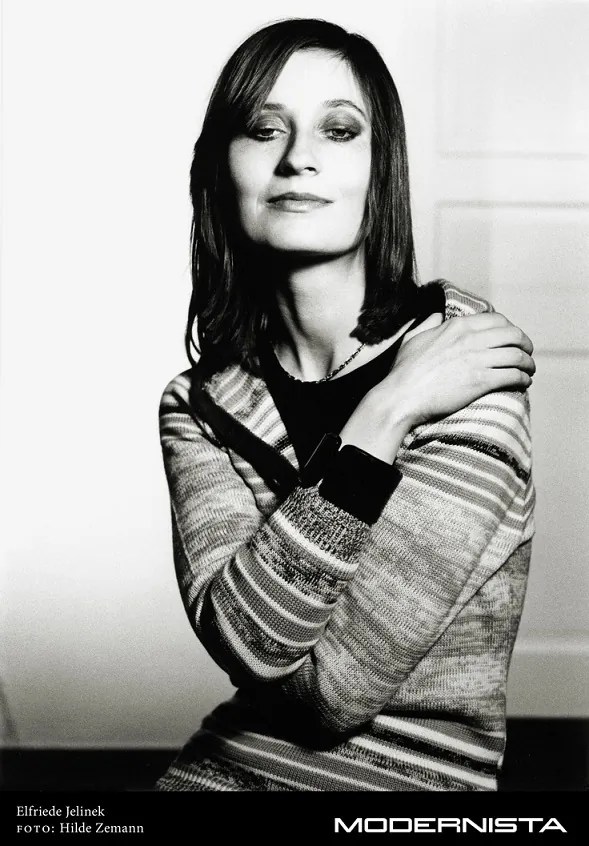
Elfriede Jelinek, born in 1946 in Mürzzuschlag, Austria, is a playwright, novelist, poet, and essayist, best known for her unflinching and often brutal critiques of Austrian society, particularly its lingering Nazi past, patriarchal structures, and consumerist culture. Awarded the Nobel Prize in Literature in 2004, Jelinek’s work is characterized by its dense, fragmented prose, its relentless interrogation of power dynamics, and its willingness to provoke and challenge audiences.
Jelinek’s early life was marked by her mother’s strict control and her father’s progressive mental decline. She was a gifted musician, trained in piano, organ, and recorder, but abandoned music for writing. Her early works, like the novel Wir sind Lockvögel Baby! (We Are Decoys, Baby!), were influenced by pop art and experimental literature. However, her writing soon evolved into a more overtly political and feminist stance.
Her breakthrough came with the novel Die Liebhaberinnen (Women as Lovers), which deconstructs romantic narratives to expose the economic and social constraints placed upon women. This marked the beginning of her exploration of the role of women in a patriarchal society, a theme that permeates much of her work. Die Klavierspielerin (The Piano Teacher), later adapted into a critically acclaimed film, further delves into the themes of sexual repression, power, and self-destruction within a dysfunctional mother-daughter relationship. This novel is painfully autobiographical, drawing from Jelinek’s own experiences and relationship with her mother.
Jelinek’s plays are particularly confrontational and experimental, often dispensing with traditional narrative structures and character development. Works like Burgtheater and Totenauberg directly confront Austria’s problematic relationship with its Nazi past, accusing the nation of collective amnesia and complicity. Her use of language is deliberately challenging, incorporating wordplay, repetition, and stream-of-consciousness techniques to create a sense of unease and disorientation.
Her work is not without controversy. Her unflinching portrayal of Austrian society and its historical baggage has made her a polarizing figure. She has been accused of being anti-Austrian and of unfairly generalizing about its citizens. Despite, or perhaps because of, the controversy, Jelinek remains one of the most important and influential contemporary writers in the German language. She refuses to shy away from difficult subjects, consistently pushing the boundaries of language and form to expose the hidden power structures that shape our world.
Beyond the controversial aspects, her Nobel Prize citation acknowledged her “musical flow of voices and counter-voices in novels and plays that with extraordinary linguistic zeal reveal the absurdity of society’s clichés and their subjugating power.” Jelinek’s work, though often challenging, offers a vital contribution to our understanding of power, gender, and the complexities of history and memory.
 1280×1519 elfriede jelinek movies bio lists mubi from mubi.com
  496×744 elfriede jelinek facts nobelprizeorg from www.nobelprize.org
  600×900 elfriede jelinek from www.themoviedb.org
  1043×1500 elfriede jelinek book cover design behance from www.behance.net
  396×571 elfriede jelinek author piano teacher from www.goodreads.com
  1152×1454 elfriede jelineks birthday celebration happybdayto from happybday.to
  1277×1390 elfriede jelinek res stock photography images alamy from www.alamy.com
  1300×1071 elfriede jelinek high resolution stock photography images alamy from www.alamy.com
  300×250 elfriede jelinek biography facts childhood family life achievements from www.thefamouspeople.com
  1710×1848 elfriede jelinek larche from www.arche-editeur.com
  1024×1001 elfriede jelinek welt from www.welt.de
  589×846 de elfriede jelinek babeliocom from www.babelio.com